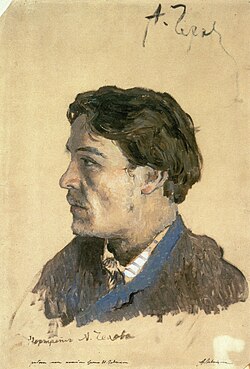
Happy birthday AC – January 29, 1860.
I did not read Anton Chekhov until I went back to Lehman College — because my wife told me that I cannot be writer if I don’t study the great writers.
There is some truth to that. I mean the only true value to a pure creative writing class as opposed to a pure literature class is that the former compels you to write, introduces you to the skill level of your future competition, and helps develops connections with gifted friends who are willing to share some magic with you.
Bukowski’s Rules – The Wise Novelist
I can honestly say that most of the writing professors I studied under (at the New School in Manhattan and Lehman in the Bronx) – with the exception Professor Clement Dunbar III – under whose one-on-one tutelage I wrote Revelations – act more like a babysitter to make sure you turn in your writing assignments.
Billy Collins was his own level of poetic genius among that all English Honors students hoped to absorb through interpersonal contact – listening to his Oscar Wilde level of quips and observations while drinking wine in the English Honors student lounge late afternoons at Lehman. One could never imagine rising to his level as a poet.
But it during the latter, pure literature classes, where one reads and analyzes another writer’s work, that teaches you what is needed in a narrative to tell a complete story that leaves you satisfied with the result, yet wanting more.
I doubled majored in English Literature and Political Science, with minors in Education and Russian Literature. For some reason I was drawn to the Russian writers. It wasn’t because I could find common ground in their backstories. My whole life couldn’t cobble together a day of their suffering. However, I could appreciate the fact that that despite the prevalent despair in most of their narratives they always eked out moments of passion, love and joy that proved their resiliency. It also showed me why водка was so ubiquitous.
What I loved about Chekov was that he knew how to tell a powerful story in abbreviated form.
For example – AC wrote 10 one-act plays, which at the time – while still an undergraduate at Lehman ’79 -’81 – provided me the literary precedent to write a trans love story, “Revelations,” in one act.
Creative History – The Wise Novelist
The rest of AC’s best work came in the form of the Short Story.
Probably my favorite of AC’s short stories was “The Bet.” I think it may have been because I read it knowing that my Political Science major was providing a pre-law foundation for my Plan B of being a lawyer should my writing Plan A never materialize. It was nice to know that lawyers maintained their humanity.
I never liked bankers after that.
Funny how I found comparable salvation as a lawyer through my own voluntary solitude here on Casa Claire.
But if I came away with anything for my writer’s quiver from reading AC, it was my wholehearted embrace of the bastardized version of his narrative principle known as “Chekhov’s gun.” (Actually, Chekhov’s Rifle).
If you introduce an object, like a gun, at the early part of a story, someone better be shot with it before the end. Putting it another way, an apparently standalone plot twist element that is introduced early in a story better provide some significance to the plot before the book ends.
My understanding/application of the principle is the idea that if you introduce a plot point early in a story, like the Bronx junkie’s mule in TWA, you better tie it back into the narrative before you finish the book. In TWA the Junkie’s mule sets the groundwork of the lesson in empathy and compassion between the Junkie, Spaghetti and young Jimmy McCarthy. The mule itself reappears later in Jimmy’s dream, and its lesson sets the groundwork for Jimmy’s deep connection with Claire the Mule, a foundational relationship that carries a morality forward through all five novels in The Claire Saga. The same can be said for the lessons of empathy learned through interactions with what most New Yorkers call “rats with wings,” taught to the young Jimmy Moran in the labyrinths below the Bronx streets. Shortly afterwards, under the Jerome Ave El, Jimmy proves that he believes all creatures are worth dying for. Those lessons took hold and played a role in that character’s conduct as a man. And if you get it when it happens, it makes the entire story that comes along later on more meaningful, because they are important lessons learned from the moments of everyday life.
Indeed, I extended the application of AC’s narrative principle by introducing retrospective mentions of characters in TWA-KMAG that reappear in greater detail in Finding Jimmy Moran, which in turn, lays out what I call easter eggs (instead of AC guns) that reappear and lay the groundwork for the final events in WTLLM.
So, whenever you read any of my Claire related work, and indeed, when (no ifs) you read Free Radical, pay attention to those little easter eggs you spot along the way, because they ultimately reappear during moments of plot resolution. If you have paid attention, it will be an added moment of reading pleasure because you were in on the secret all along.
So, thank you Anton Chekhov, your gun principle has provided me the most fun when it comes to my own writing. And happy birthday.
Now for you of my fine, five readers that needs to go into your office to earn your paycheck, make Thursday carry the load so you can wrap up the projects for the week. Friday is your getaway car, and it will be there in the office’s side alley pointed towards the weekend and revving its engines.
And no matter what else we get up to, let us make today a great one.

3 Responses
This is one of the better posts among all your great posts. From now on, I will remember Chekhov’s Gun Principle. Thank you for teaching me. JL
Turnabout is fair play, Joe, given that your novel Black Yéʼii – https://jrlewisauthor.com/books/black-ye%ca%bcii-the-evil-one/ – is doing a fine job in teaching me what good writing is meant to look like. Hope to finish it by the weekend.
You are way to kind. Thank you.