As I sit here with my coffee in the early morning darkness of my office searching for a topic that I can write about, I scan all of my social media and emails looking for inspiration. Something that I can improvise. As a wordsmith, it should come as no surprise that I often draw that inspiration from words.
One of my favorite sources of inspiring information is Home – Inspiring Quotes.
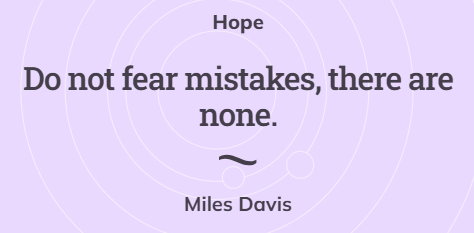
This morning, it was the above quote from Miles Davis that caught my eye.
Now I wish I could say with any confidence that I understand Jazz as a form of music. I was first exposed to jazz in the Boris Claudio “Lalo” Schifrin soundtrack to the still awesome 1969 film, Bullitt. Since then, I’ve tried on many occasions to attempt its appreciation. I can listen to it, and even enjoy it, without understanding it in the same way that I can listen to and derive the story told in a pop song or power ballad. But I have been around long enough to know that there are certain artists that are respected as gods of the form. Miles Davis is one in that pantheon.
https://youtu.be/YHx1-BPgkkM?si=WzRXC73hifRHnLUO
And Mile’s quote about “mistakes” resonated with me. As I wrap my 70th trip around the globe, and oddly enough no longer give a shit about what other people think of me, I now absolutely understand and fully appreciate that in art, as in life, you cannot succeed if you fear making a mistake.
When I first tried my hand at writing, I was so worried about what creative writing and English literature professors kept telling me was the right and only way to write, that I couldn’t write at all. I was afraid that someone would read what I wrote and expose me as a poser and fraud because I couldn’t or wouldn’t follow the generally accepted rules of what makes writing good.
[Don’t get me started on discussing my chronic “imposter syndrome.” Hump Days Are Just Fine – The Great Imposter – The Wise Novelist.]
I was afraid of making a mistake.
And maybe that’s where the concept of Jazz as an artform comes in. Instead of following the classical form of music that had slowly evolved over the centuries, it is improvised. (To this day, I’m not sure how there can be any written publishing form of a popular jazz song, given that, if the artist remains true to form, you can never really see it performed live twice in the exact same way. So, at best you can write down an outline. The performer always puts the meat on the bones and never in the same way.)
And it’s this spontaneous improvisation of rhythm and harmony that draws the jazz aficionados. They repeatedly come back to watch a popular jazz band or soloist perform because they will never experience the exact same music twice.
Conceptually, since there can be no mistakes in jazz, it frees the artist to take the listener wherever they want. They can create without fear of breaking rules.
A variation of this proof of concept can be found in painting. Jackson Pollock – Wikipedia.
When I sat down to write The Wise Ass, I made a conscious decision to ignore every rule of creative writing I had ever been taught (including splitting infinitives). I only knew when I started that I wanted to tell a story in the best way I could. I stopped worrying about making mistakes and just started typing. Twelve weeks later I completed my first novel, warts and all, but no mistakes. I’ve written the six novels that followed with the same fearlessness (or recklessness, you decide.)
So, if I were ever lucky enough to teach a group of young people a course in creative writing, I would start out by playing them a jazz piece – maybe Miles Davis – and tell them to string their words together with the same passion found in those improvised notes and not worry about making a mistake. As Miles shows us, there are none.
Well, my fine, five readers, we’ve reached another Thursday, Friday’s handmaiden. You are almost there. The weekend beckons.
So, gulp down that last cuppa, pull up your socks and launch into your Thursday. Use every moment to wrap and polish whatever project you are working on. Get it done before you turn off the office lights at the COB, because you don’t want to be still fucking with on Friday. If the normal rules aren’t working for you, improvise.
And, no matter what else we get up, let us make today a great one.
2 Responses
I like the concepts of no rules and improvisation. I have been, and am, a stickler for rules. Hmm, we will see.
Jazz is about improvising and being spontaneous; it makes this reader feel more alive. Rock also does that. There’s this energy you get from it. Both music forms give musicians and listeners a sense of freedom. I listen to Jazz and Rock when I want something upbeat that’ll make me want to dance, and I turn to Blues when I need to sit and process my own heartbreak and disappointment. These forms of music are created from the heart and soul. Miles, Brubeck, Monk, and so many other greats did that. Pollack, Klee, Dali, Van Gogh, DaVinci, even Rembrandt, and all those artists created art that expressed emotion and grabbed people’s attention.
Authors do that too. Steinbeck, Hemingway, Capote, Baldwin, etc., tap into a reader’s emotions.
Having read all of your books,Tom, I could tell early on that you were writing from a place deep in your soul. I fell in love with Claire from her first encounter with Jimmy. And having been privileged to read Free R.A.D.I.C.A.L and Spark of Faith, I know that you’re doing the right thing by not following convention.
Aside from any possible spelling, punctuation and grammatical errors a reader may find, the most important thing is that you and other authors such as yourself are telling stories that capture everyone’s imagination, because, let’s face it, reality sucks. And, we all need an escape.